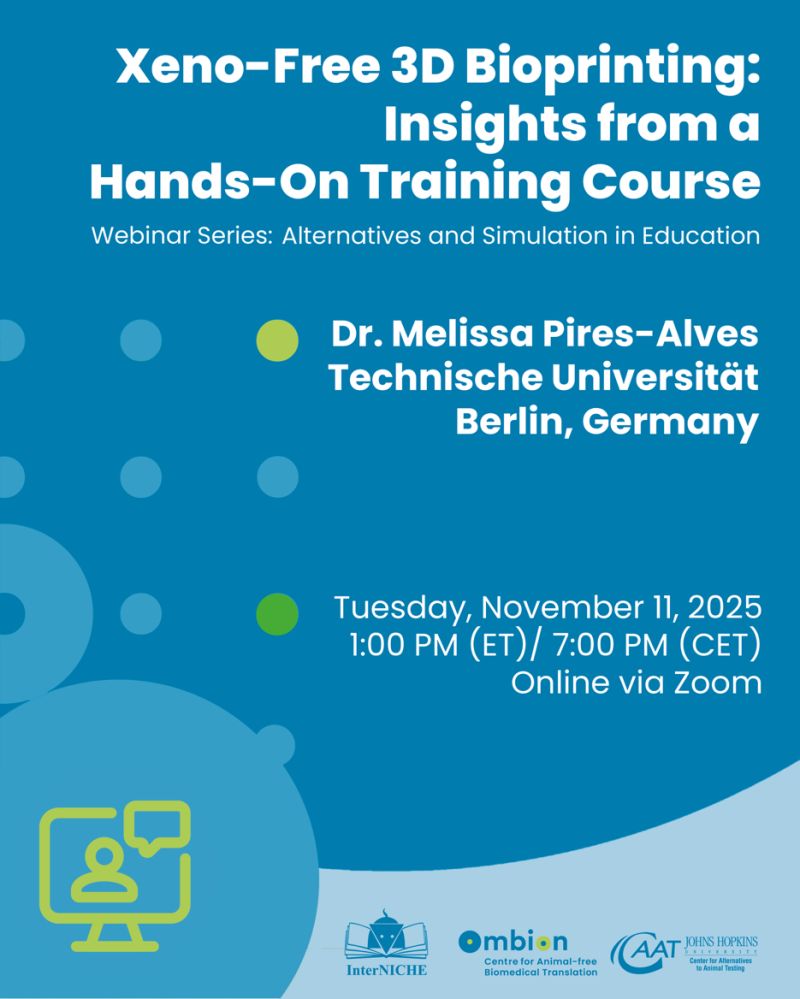
New webinar series starting November 11, 2025
Alternatives and Simulation in Education
InterNICHE, along with the Johns Hopkins Center for Alternatives to Animal Testing (CAAT) and Ombion are together launching a new webinar series that continues the dialogue from the International Conference on Alternatives and Simulation in Education (Rio, 2025) - a satellite of the 13th World Congress on Alternatives and Animal Use in the Life Sciences.
Monthly webinars will feature expert talks on real-world implementation, showcasing initiatives and transformations in two distinct but mutually supportive areas:
* Education through the use of humane, innovative learning tools and alternatives to animal experiments. This focuses on acquisition of knowledge, skills and attitudes in student practical classes within biology, medical and veterinary medical education.
* Progress in science through education and training in cutting edge non-animal methods (NAMs). This supports the next generation of scientists and others in research and testing in practically applying the latest scientific, technological and ethical innovations.
The link between humane education and humane science, and the pathways to ethical careers, will also be explored.
First topic: Xeno-Free 3D Bioprinting: Insights from a Hands-On Training Course
Speaker: Dr. Melissa Pires-Alves, Technische Universität Berlin
Date: November 11, 2025
Time: 10am PST / 1pm ET / 6pm GMT / 7pm CET / 11.30pm IST
Free registration: Free registration: https://www.eventbrite.co.uk/e/alternatives-and-simulation-in-education-xeno-free-3d-bioprinting-tickets-1810505985139
Participants attending the full session will receive a Certificate of Attendance.
Summary:
Dr. Pires-Alves will present a TU Berlin Master’s-level course integrating ethics, cell culture, and 3D bioprinting using xeno-free media and bioinks. The talk illustrates how combining ethical awareness with technical training empowers future scientists to drive animal-free innovation in biomedical research.
Abstract:
Biomedical science education continues to rely heavily on animal-based experimentation, despite the growing availability of ethical and innovative alternatives. Technologies such as organoids, organ-on-chip systems, and 3D bioprinting are reshaping biomedical research — yet many still depend on animal-derived components such as fetal bovine serum (FBS), Matrigel, or porcine trypsin. To overcome these limitations, Dr. Pires-Alves and colleagues at TU Berlin developed a Master’s-level course integrating lectures on cell culture, ethics, and bioprinting with hands-on laboratory work focused on xeno-free methodologies. Students cultivated cell lines in animal-free media, used recombinant enzymes for passaging, prepared xenofree bioinks, and bioprinted 3D liver constructs assessed through viability and metabolic assays. The presentation will share educational insights, student outcomes, and experimental results — demonstrating how the integration of ethics, technology, and practice can foster a new generation of researchers equipped to advance animal-free innovation in biomedical science.
Biography:
Dr. Melissa Pires-Alves earned her PhD from the Center for Biotechnology at the Federal University of Rio Grande do Sul (UFRGS), Brazil. She completed her postdoctoral research and subsequent work as a research scientist at the University of Illinois at Urbana-Champaign, USA, before joining Prof. Dr. Kurreck’s group at the Technical University of Berlin in 2023. She focuses on bioprinting, siRNA technologies, and virology, with a strong commitment to developing alternative models that reduce and replace animal use in science.